

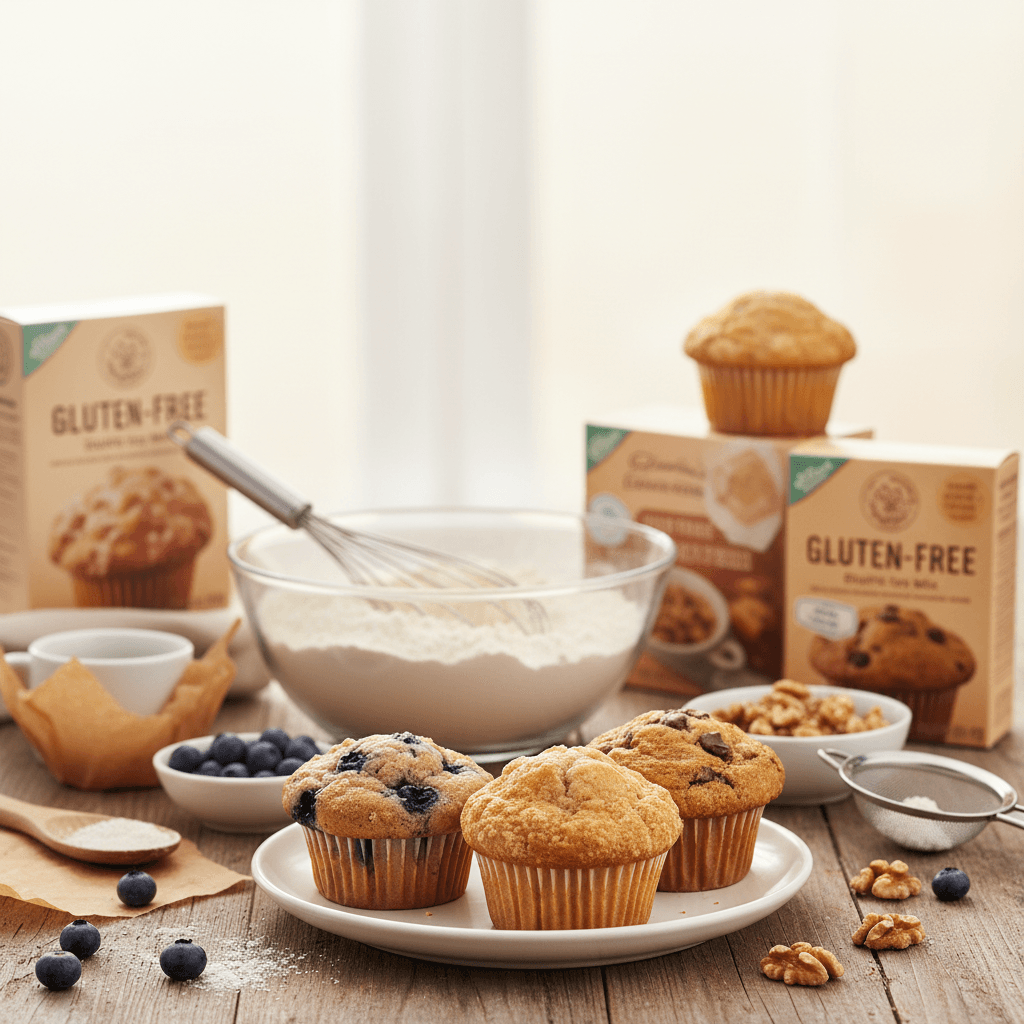
Finding a gluten-free muffin mix that actually tastes good and doesn't crumble apart can feel like a guessing game, especially when you're staring at a wall of options at the store. We've compared the most popular mixes on ingredients, certification, allergens, and ease so you don't have to waste money on disappointing results.
Quick-pick summary: the best gluten-free muffin mixes at a glance
| Mix | Best for | Certified GF | Dairy-free option |
|---|---|---|---|
| King Arthur Gluten Free Muffin Mix | Best overall | Yes | Yes (with swaps) |
| Bob's Red Mill Gluten Free Muffin Mix | Best budget pick | Yes | Yes (with swaps) |
| Simple Mills Almond Flour Muffin Mix | Best clean ingredients | Yes | Yes (no dairy ingredients; contains almonds) |
| Krusteaz Gluten Free Blueberry Muffin Mix | Best grab-and-go convenience | Yes | No |
| Pamela's Cornbread & Muffin Mix | Best corn muffins | Yes (GFCO) | No dairy in mix (directions use butter; shared equipment with milk) |
| Namaste Foods Muffin & Scone Mix | Best for multiple food allergies | Yes (GFCO-certified facility) | Yes (no dairy; made in an allergen-free facility) |
| Miss Jones Baking Co. Blueberry Muffin Mix | Best for kids | Yes | Yes (with swaps) |
Key takeaways
- King Arthur Gluten Free Muffin Mix delivers the closest-to-conventional texture and flavor, making it our top overall pick for beginners and experienced bakers alike.
- Certified gluten-free labeling matters. Look for a third-party seal (such as GFCO) on the box you buy, and check the allergen and shared-equipment statements if you have other allergies.
- Mixes made with a blend of rice flour and starches (like tapioca or potato) tend to produce the most tender, least gritty muffins.
- If you have additional dietary restrictions, Simple Mills offers grain-free, paleo-friendly options built around almond flour. Pamela's mixes are rice-flour based, so they aren't grain-free.
- Most mixes only require eggs, oil, and milk — making them perfect for busy mornings or first-time gluten-free bakers who aren't ready to build a recipe from scratch.
- Storing muffins properly helps prevent the quick staling that's common in gluten-free baked goods.
What to look for when buying a gluten-free muffin mix
Before we get into specific products, here's what actually matters when you're choosing a mix. These are the things that separate a great gluten-free muffin from a dry, crumbly disappointment.
Certification and labeling
Always look for a certified gluten-free label, not just "made without gluten ingredients." Any product labeled gluten-free must meet the FDA limit of fewer than 20 parts per million of gluten. Third-party certification adds independent audits and testing on top of that; GFCO, for example, requires testing below 10 ppm. This is especially important if you have celiac disease rather than a sensitivity.
Flour blend composition
The best mixes use a thoughtful combination of flours and starches. A mix of brown rice flour with arrowroot or tapioca starch tends to give you a tender crumb without grittiness. If you want to understand why some flours work better than others, our guide to the best gluten-free flour for cakes covers the same principles that apply to muffins.
Binder ingredients
Gluten-free muffins need something to hold them together since there's no gluten network. Most mixes include xanthan gum or guar gum. Both work well — if you're curious about the differences, we have a full breakdown of xanthan gum vs guar gum.
Sugar and add-ins
Some mixes come heavily sweetened, while others let you control the sugar. If you're watching sugar intake, look at the nutrition label — some blueberry muffin mixes pack more sugar than a dessert. Also check whether fruit or chocolate chips are included or if you need to add your own.
Allergen overlap
Many gluten-free mixes still contain dairy, eggs, soy, or tree nuts. If you're managing multiple food allergies, read the full ingredient list and allergen warnings carefully. We'll flag common allergens for each mix below.
If you're just getting started with gluten-free baking and want to build confidence beyond mixes, our Confident Gluten-Free Baker Toolkit walks you through everything from pantry setup to troubleshooting common texture problems. It's a great next step once you're comfortable with mixes and ready to try recipes from scratch.
1. King Arthur Gluten Free Muffin Mix — best overall
King Arthur's gluten-free muffin mix is the most reliable, versatile option on this list. Its rice flour and starch blend is designed for a tender, moist crumb close to what you'd get from a regular bakery.

The mix uses a blend of rice flour, tapioca starch, and potato starch, which creates that soft, slightly springy texture that's hard to achieve in gluten-free baking. It also includes xanthan gum, so you don't need to add your own binder. The flavor is neutral enough to work as a base for blueberry, chocolate chip, banana, or any add-in you like.
Pros:
- Certified gluten-free with rigorous testing standards
- Versatile plain base works with any flavor variation
- Excellent crumb structure — not gummy, not crumbly
- Widely available in grocery stores and online
Cons:
- No dairy ingredients in the mix, but it's made on equipment that also processes milk, eggs, soy, wheat, and almonds
- Slightly more expensive than some competitors
- Plain flavor means you need to add your own mix-ins
We recommend the King Arthur Gluten Free Muffin Mix as the starting point for anyone new to gluten-free baking. It's forgiving, consistent, and hard to mess up.
2. Bob's Red Mill Gluten Free Muffin Mix — best budget pick
Bob's Red Mill delivers solid results at a lower price point than most competitors. The muffins come out with a nice dome and a slightly denser crumb than King Arthur, but still moist and flavorful.
This mix relies on a combination of whole grain sorghum flour, potato starch, and tapioca flour. The sorghum gives a slightly heartier, more whole-grain flavor that works particularly well in banana or pumpkin muffins. If you've been comparing Bob's Red Mill and King Arthur products in general, our Bob's Red Mill vs King Arthur comparison covers their flour blends in detail.
Pros:
- Certified gluten-free and tested in dedicated GF facility
- Budget-friendly — often under $5 per package
- Whole grain sorghum adds nutritional value and a pleasant flavor
- Easy to find at most grocery stores
Cons:
- Slightly denser texture than premium mixes
- Can taste a bit "grainy" if overbaked
- Requires careful timing — pull them out as soon as a toothpick comes out clean
Pick up the Bob's Red Mill Gluten Free Muffin Mix if you want a reliable everyday option without spending a lot.
3. Simple Mills Almond Flour Muffin and Cake Mix — best clean ingredients
Simple Mills takes a completely different approach by building their mix around almond flour instead of rice flour. The result is a naturally moist, protein-rich muffin with a short, recognizable ingredient list.
The mix contains almond flour, coconut sugar, arrowroot, tapioca, and coconut flour — all ingredients you could find in your own pantry. There's no xanthan gum, no guar gum, and no refined sugars. The almond flour base means these muffins are naturally grain-free and paleo-friendly, which is a bonus if you're following those diets alongside gluten-free.
Pros:
- Clean, recognizable ingredient list with no gums or fillers
- Naturally grain-free and paleo-friendly
- Moist texture thanks to almond flour's fat content
- Available in banana and pumpkin flavors that taste genuinely good
Cons:
- Not suitable for tree nut allergies
- Denser, more crumbly texture than traditional muffins
- Higher price per serving than flour-blend-based mixes
- Coconut sugar gives a distinct flavor that not everyone loves
Try the Simple Mills Almond Flour Muffin and Cake Mix if ingredient quality is your top priority.
4. Krusteaz Gluten Free Blueberry Muffin Mix — best grab-and-go convenience
Krusteaz makes gluten-free baking about as easy as it gets. This mix comes with freeze-dried blueberries already included, so all you add is water, oil, and an egg. That's it.
The texture is surprisingly good for such a simple preparation — soft, fluffy, and not at all gummy. The blueberries rehydrate during baking and distribute evenly throughout the muffin. It's a great option for busy mornings or when you want to bake with kids without measuring a bunch of add-ins.
Pros:
- Blueberries included — minimal prep required
- Certified gluten-free
- Light, fluffy texture that rivals conventional mixes
- Very affordable
Cons:
- Only available in blueberry flavor
- Contains more sugar than some competitors
- Less versatile since the flavor is already determined
- Freeze-dried blueberries can taste slightly artificial to some palates
Grab the Krusteaz Gluten Free Blueberry Muffin Mix when you want minimal effort and maximum convenience.
5. Pamela's Cornbread & Muffin Mix — best corn muffins
If you want corn muffins rather than a sweet bakery-style muffin, Pamela's Cornbread & Muffin Mix is built for it. The base is organic degermed corn meal with brown, white, and sweet rice flours, tapioca and potato starch, and organic corn flour, with xanthan gum as the binder, so you don't need to add your own.
Pamela's says the mix is GFCO-certified gluten-free and made in a gluten-free certified, peanut-free facility. The mix itself has no dairy, nut, or soy ingredients, but it's produced on equipment that also processes tree nuts, coconut, eggs, soy, and milk. For muffins, the directions call for sugar, melted butter, two eggs, and water or milk, and one 12 oz bag makes a dozen corn muffins or an 8-inch square pan of cornbread.
Pros:
- GFCO-certified gluten-free
- Made with organic corn meal and corn flour
- Xanthan gum already in the mix
- Doubles as a cornbread mix
Cons:
- Makes corn muffins, not a neutral base for blueberry or chocolate chip
- Contains corn, which some gluten-free bakers also avoid
- Made on equipment that also processes tree nuts, coconut, eggs, soy, and milk
- Directions call for butter and eggs, so dairy-free baking needs swaps
Pick up Pamela's Cornbread & Muffin Mix if you want corn muffins to serve with chili or soup. And if you like making muffins in batches, check out our guide to gluten-free muffin recipes for meal prep for tips on freezing and reheating.
6. Namaste Foods Muffin & Scone Mix — best for multiple food allergies
If gluten isn't the only thing you're avoiding, Namaste Foods is built for that. Its Muffin & Scone Mix is labeled free from wheat, gluten, dairy, egg, peanuts, tree nuts, soy, fish, shellfish, sulfites, sesame, celery, lupins, crustaceans, and mustard. Namaste says all of its products are made in its own dedicated gluten- and allergen-free facility, certified by the Gluten-Free Certification Organization (GFCO), with regular ELISA testing to below 10 ppm gluten.
The mix is built on brown rice flour with cane sugar, tapioca and/or arrowroot starch, rice syrup solids, and citrus fiber, leavened with cream of tartar and baking soda and flavored with ground vanilla bean. No xanthan or guar gum appears in the ingredient list. As the name says, the same bag makes scones as well as muffins, and Namaste suggests adding fruit or spices to customize it. It's Non-GMO Project Verified and kosher, and Namaste lists the 16 oz bag at $6.09 on its own site.
Pros:
- Free from the major allergens, including dairy, egg, soy, peanuts, and tree nuts
- Made in a dedicated gluten- and allergen-free facility certified by GFCO
- One bag works for muffins or scones
- No gums in the ingredient list
Cons:
- Plain vanilla base, so mix-ins are up to you
- Rice-based, so not grain-free
- Not organic (Namaste's organic option is its separate Organic Quick Bread & Muffin Mix)
Try the Namaste Foods Muffin & Scone Mix if you're baking for someone with several food allergies.
7. Miss Jones Baking Co. Blueberry Muffin Mix — best for kids
Miss Jones uses organic ingredients and keeps the sugar content lower than most competitors, making it a solid choice for families. The muffins are soft, lightly sweet, and have a mild flavor that even picky eaters tend to accept.
The mix uses a combination of rice flour and tapioca starch with organic cane sugar. The blueberry flavor is subtle rather than overwhelming, and the texture stays soft even the next day — which matters when you're packing school lunches.
Pros:
- Organic ingredients with lower sugar content
- Certified gluten-free
- Soft, kid-friendly texture and flavor
- Stays fresh longer than many GF muffins
Cons:
- Flavor is very mild — adults may find it bland
- Smaller yield per box than some competitors
- Can be tricky to find in physical stores
- Blueberry pieces are small and sparse
Try the Miss Jones Baking Co. Blueberry Muffin Mix if you're baking for little ones or prefer a less sweet muffin.
Tips for getting the best results from any gluten-free muffin mix
Even with a great mix, a few small adjustments can make a big difference in your results.
- Don't overmix the batter. Gluten-free batters don't need much mixing since there's no gluten to develop. Stir until just combined — lumps are fine.
- Let the batter rest for 5-10 minutes. This gives the starches time to hydrate, which improves texture and reduces grittiness.
- Use an ice cream scoop for even portions. Consistent sizing means even baking. Overfilling cups leads to gummy centers.
- Bake at the right temperature. Most mixes call for 350-375 degrees F. An accurate oven thermometer helps ensure your oven isn't running hot or cold.
- Cool in the pan for 5 minutes, then transfer to a wire rack. This prevents the bottoms from getting soggy while letting residual heat finish cooking the centers.
Frequently asked questions
Are gluten-free muffin mixes safe for celiac disease?
Look for a mix labeled gluten-free, which means it must contain fewer than 20 ppm of gluten under FDA rules. Ideally, choose one with a third-party certification seal such as GFCO, which requires testing below 10 ppm. Check the box you buy, since labels and certifications can change. However, always check for cross-contamination warnings if you have severe sensitivity, and make sure your kitchen is set up to avoid contamination — our guide on how to set up a gluten-free baking kitchen covers this in detail.
Why are my gluten-free muffins dry and crumbly?
The most common reasons are overbaking and not enough fat or moisture. Gluten-free muffins go from perfectly done to dry very quickly, so start checking 2-3 minutes before the suggested bake time. Adding an extra tablespoon of oil or using buttermilk instead of regular milk can also help. Our troubleshooting guide for dry, crumbly gluten-free bakes has more solutions.
Can you make gluten-free muffin mix without eggs?
Most mixes require eggs for structure and moisture, but you can often substitute with flax eggs (1 tablespoon ground flax plus 3 tablespoons water per egg) or commercial egg replacers. The texture will be slightly denser. Check our guide to choosing egg substitutes for the best option based on what you're making.
How do you store gluten-free muffins to keep them fresh?
Store muffins in an airtight container at room temperature for up to 2 days, or freeze them for up to 3 months. Gluten-free baked goods stale faster than wheat-based ones because they lack the gluten network that traps moisture. Wrapping individual muffins in plastic wrap before freezing gives you the best results when you reheat them.
Is it cheaper to make gluten-free muffins from scratch instead of using a mix?
Generally yes, especially if you bake frequently. A bag of gluten-free flour blend can make several batches of muffins for the price of two or three boxed mixes. However, mixes are a great starting point if you're new to gluten-free baking and want consistent results while you build confidence with ingredients and techniques.

Written by
Co-founder, BakingSubs
Co-founder of BakingSubs, where he turns the science of ingredient substitutions into tested, reliable guidance for home bakers.
Related Posts
Bake with Confidence
See all
Confident Gluten-Free Baker Toolkit
The science-based system that replaces gluten's seven invisible jobs so your baking turns out soft, fluffy, and foolproof — every time.

Gluten-Free Recipe Vault
Instant access to our complete library of proven gluten-free recipes — no waiting, no guesswork, just results that work tonight.

Fix Your Gluten-Free Bread
Learn the 3-step formula to make bread rise and stay soft, discover why your loaves collapse, and get a tested sandwich bread recipe that actually works.